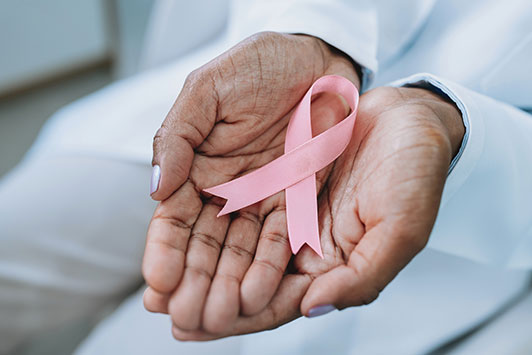
October is Breast Cancer Awareness Month, a time to recognize survivors, support those currently undergoing treatment, remember those we have lost, and continue important conversations about breast health.
At Denver Plastic Surgery & Aesthetics, breast cancer care is especially meaningful to us.
For women who undergo mastectomy and breast reconstruction, one of the things we want patients to understand is that reconstruction is not always a single surgery with a defined endpoint.
For many women, breast reconstruction is a journey.
The first operation may rebuild the breast after a mastectomy, but healing continues. Cancer treatment may continue. Reconstructed tissue settles. Radiation can affect the skin and underlying tissues. The natural breast changes with age. Implants, scars, breast shape, symmetry, and even a patient’s goals may change over time.
Months—or even years—after completing breast cancer treatment, a woman may decide there are things about her reconstruction she would like to improve.
That does not mean the original reconstruction failed.
It simply means that bodies change, priorities change, and breast reconstruction can evolve along with them.
The First Reconstruction Does Not Always Have to Be the Last Surgery
Breast reconstruction frequently involves more than one procedure, and in many cases this is expected from the beginning.
Implant-based reconstruction, for example, may involve placement of a tissue expander followed later by a permanent implant. Other patients may have reconstruction using their own tissue. Additional procedures can then be used to improve breast contour, symmetry, scars, or the nipple and areola.
Some women complete these stages relatively close together.
Others may be very happy with their reconstruction for years before noticing changes they would like to address.
There is no universal timeline.
The important thing is knowing that you can revisit your reconstruction if something begins to bother you.
Why Breast Reconstruction Can Change Over Time
A reconstructed breast does not exist separately from the rest of the body.
Skin ages. Weight changes. Hormonal changes occur. The natural breast may become lower or lose volume while a reconstructed breast changes differently.
Cancer treatment can also affect the long-term appearance and feel of the breast.
Radiation, in particular, may cause the skin and deeper tissues to become firmer or less elastic. Scar tissue can change. An implant can shift or become more visible. Differences between the reconstructed breast and the natural breast may become more noticeable over time.
None of these changes automatically mean another surgery is necessary.
The better question is:
Does something bother you enough that you would like to know whether it can be improved?
Sometimes the answer is yes.
Sometimes the best recommendation is to leave things alone.
A consultation can help you understand the difference.
Improving Breast Symmetry After Reconstruction
Perfect symmetry is not a realistic expectation for any pair of breasts—reconstructed or natural.
However, significant differences in breast size, shape, position, or contour can sometimes be improved.
This is particularly common when only one breast has been reconstructed.
The natural breast continues to age and change while the reconstructed breast may behave differently. A breast that was relatively symmetrical after surgery may look less balanced several years later.
Depending on the patient’s anatomy and goals, improving symmetry may involve:
- Breast lift
- Breast reduction
- Breast augmentation of the opposite breast
- Implant replacement or repositioning
- Adjustment of the implant pocket
- Fat grafting
- Revision of excess skin
- Correction of contour irregularities
The goal is not necessarily to make the breasts identical.
It is to create better balance and help the patient feel more comfortable with her result.
Fat Grafting Can Be an Important Part of Reconstruction
Fat grafting has become an extremely useful tool for refining breast reconstruction.
During fat grafting, fat is removed from another area of the body using liposuction, carefully processed, and transferred to areas of the reconstructed breast where additional volume or softness may be helpful.
Fat grafting may be used to:
- Soften visible implant edges
- Fill small indentations or contour irregularities
- Improve the transition between the chest and reconstructed breast
- Add subtle volume
- Improve areas of hollowing
- Refine an otherwise successful breast reconstruction
Fat grafting is generally considered a refinement technique rather than a replacement for the primary reconstruction.
Some patients may also require more than one fat-grafting session because not all transferred fat survives permanently.
What About Breast Reconstruction Scars?
Scars are an unavoidable part of mastectomy and breast reconstruction.
They also change significantly with time.
Early scars can be pink, firm, raised, or much more noticeable than patients expect. As healing progresses, many gradually soften and fade.
Some scars, however, remain thick, tethered, widened, uncomfortable, or visually distracting.
Depending on the concern, treatment might include scar revision or other therapies aimed at improving redness, pigmentation, or texture.
Patients should also remember that a scar several months after surgery is not necessarily a finished scar.
Healing continues for many months, and sometimes longer.
The Nipple and Areola May Be Addressed Later
Depending on the type of mastectomy performed, the nipple and areola may or may not be preserved.
When they are removed, nipple and areola reconstruction can sometimes be performed after the breast has healed and settled.
Options may include surgical nipple reconstruction, medical tattooing, or a combination of techniques.
For some women, this final stage helps the reconstructed breast feel more complete.
Other women decide they do not want nipple reconstruction at all.
Both choices are completely valid.
There is no requirement to keep pursuing additional stages of reconstruction unless they matter to you.
Sensation Is Becoming a Bigger Part of the Reconstruction Conversation
One of the realities of mastectomy is that breast and nipple sensation may be reduced or lost because nerves are disrupted during surgery.
Increasingly, reconstructive surgeons are also considering sensation as part of the reconstruction process.
In selected patients, nerve reconstruction or nerve grafting may be incorporated with the goal of improving the potential for sensation over time.
Whether this is possible depends on many factors, including the type of mastectomy, reconstruction technique, available nerves, previous treatment, and an individual patient’s anatomy.
Restoration of sensation cannot be guaranteed.
But it represents an important evolution in breast reconstruction.
Reconstruction is no longer only about rebuilding breast volume. Whenever possible, the conversation can also include shape, softness, symmetry, sensation, and how the reconstructed breast feels to the patient.
Implant-Based Reconstruction May Need Attention Years Later
Women who have implant-based breast reconstruction may eventually need their implants evaluated or revised.
That does not mean breast implants automatically need to be replaced because a certain number of years has passed.
There is no universal expiration date that requires every patient to replace an intact implant simply because it reaches a particular age.
Reasons someone might consider revisional surgery include:
- Implant rupture
- Capsular contracture or increasing firmness
- Changes in implant position
- Visible rippling
- Increasing asymmetry
- Changes in breast shape
- Discomfort
- A desire for a different size or implant
- Changes in the surrounding breast pocket or skin
Sometimes the implant itself is not actually the main problem.
The surrounding skin, scar tissue, or breast pocket may be contributing to what the patient sees or feels.
That is why an individual evaluation is so important.
Radiation Can Make Revision More Complex
Radiation therapy is an important part of breast cancer treatment for many women, but it can also affect the tissues involved in reconstruction.
Radiated skin can become tighter, less elastic, or more difficult to work with surgically. Scar tissue can affect the pocket around an implant, and healing may be less predictable.
For this reason, revisional reconstruction after radiation requires thoughtful planning.
Some women may benefit from relatively small refinements.
Others may need a different reconstructive approach.
The right recommendation depends on the patient’s entire cancer-treatment and surgical history—not simply what the breast looks like today.
You Can Revisit Reconstruction Years Later
One misconception we would especially like to change is the idea that if you did not pursue a revision immediately after breast cancer treatment, you somehow missed your opportunity.
You did not.
Women can return months or even years after their original reconstruction to discuss changes that bother them.
For many patients, that timing makes complete sense.
During cancer treatment, the priorities are survival, treatment, recovery, family, work, and trying to regain some sense of normalcy.
A woman may not be thinking about a small contour irregularity or asymmetry while she is undergoing chemotherapy, radiation, or multiple surgeries.
Years later, she may finally have the emotional space to think:
“I survived. Now I would like to address this.”
That is completely reasonable.
There is no deadline for wanting to feel more comfortable in your body.
Reconstruction Is Personal
There is another message worth emphasizing during Breast Cancer Awareness Month:
Not every woman wants reconstruction.
Some women choose implants.
Some choose reconstruction using their own tissue.
Some undergo several stages of reconstruction.
Some stop after one procedure.
Some pursue delayed reconstruction years later.
Others choose an aesthetic flat closure and never want another breast operation.
All of these decisions are valid.
Breast reconstruction should never be about creating someone else’s idea of what a woman is supposed to look like after cancer.
It should be about giving each patient information, options, and the ability to decide what feels right for her.
A Longstanding Commitment to Breast Cancer Patients
Breast cancer care has a particularly personal history at Denver Plastic Surgery & Aesthetics.
Dr. Christine Rodgers is herself a breast cancer survivor.
Long before her own diagnosis, Dr. Rodgers spent many years performing breast reconstruction and caring for women as they navigated mastectomy, reconstruction, recovery, and life after breast cancer.
Her commitment to breast cancer patients has also extended far beyond the operating room.
Throughout the years, Dr. Rodgers has supported women affected by breast cancer through community programs and outreach efforts, including offering free dance classes that provided survivors an opportunity to move, connect, regain confidence, and simply enjoy being together.
That history has helped shape a philosophy that remains deeply important to our practice today:
Breast cancer care does not end when treatment ends.
Reconstruction is only one part of recovery.
Feeling comfortable in your body again, rebuilding confidence, addressing concerns that arise years later, and knowing you still have somewhere to turn are all part of the journey.
Today, Dr. Cecelia Nguyen continues that commitment through breast reconstruction and revisional breast surgery, while Dr. Rodgers brings a perspective shaped by decades of caring for breast cancer patients as a plastic surgeon—and by experiencing breast cancer herself.
For our team, Breast Cancer Awareness Month is therefore much more than a reminder to wear pink.
It represents women we have cared for, relationships we have built, survivors we celebrate, and a community that has been an important part of Denver Plastic Surgery & Aesthetics for many years.
Long-Term Breast Reconstruction Care in Denver
If you underwent breast reconstruction months or years ago and have questions about asymmetry, implants, scars, breast contour, fat grafting, or whether a revision could improve your result, you can always revisit the conversation.
You do not have to decide that something is “bad enough” before asking.
And scheduling a consultation does not mean you are committing to another surgery.
Sometimes the most valuable first step is simply understanding what can be changed, what is best left alone, and what options are available to you.
Because breast reconstruction is not always one operation.
For many women, it truly is a journey.
Join Us for the Susan G. Komen Colorado MORE THAN PINK Walk
This October, we would also love for our patients, friends, families, and community to join Denver Plastic Surgery & Aesthetics in supporting the fight against breast cancer.
Our team will be participating in the Susan G. Komen Colorado MORE THAN PINK Walk on October 17 at City Park.
Whether you are a breast cancer survivor, currently undergoing treatment, walking in honor or memory of someone you love, or simply want to support the breast cancer community, we would be honored to have you alongside us.
There are several ways to participate:
- Join our team and walk with us on October 17
- Donate to support our team and Susan G. Komen
- Share our fundraising page with friends and family
- Come out and help us celebrate and support breast cancer survivors throughout our community
Every contribution helps support Susan G. Komen’s work in breast cancer research, advocacy, patient support, and access to care.
Join our team or make a donation here:
https://secure.info-komen.org/site/TR/RacefortheCure/MoreThanPinkWalk?pg=team&team_id=515730&fr_id=11252
Susan G. Komen Colorado MORE THAN PINK Walk
October 17, 2026
City Park
We hope to see you there, and we are grateful to every person who walks, donates, shares, or supports this cause alongside us.