Summer is great for a lot of things.
Your skin may disagree.
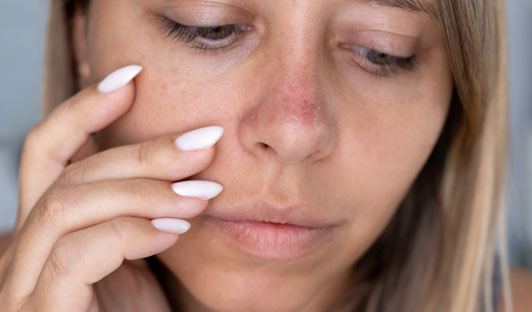
By the time fall arrives, many patients start noticing changes that seemed to show up almost overnight. Brown spots look darker. Freckles are more noticeable. Redness seems harder to cover. Skin feels rougher, duller, or less even. Fine lines that were barely noticeable a few months ago suddenly seem a little more obvious.
The reality is that most of this did not happen overnight.
Sun damage is cumulative. Every summer adds to the UV exposure your skin has experienced over the years, and eventually that damage becomes visible as pigmentation, redness, uneven texture, fine lines, and other signs of photoaging.
The good news is that there are treatments that can significantly improve many of those changes.
The harder part is figuring out which treatment you actually need.
Because brown spots, redness, rough texture, and wrinkles are not the same problem, and treating all of them the same way usually does not give you the best result.
First, What Does Sun Damage Actually Look Like?
When people hear “sun damage,” they usually think of brown spots.
That is definitely part of it, but UV exposure can affect the skin in several different ways.
You may notice:
- Brown spots or sun spots
- Freckles that have become darker or more numerous
- Uneven pigmentation
- Redness or visible blood vessels
- Dull or rough skin texture
- Enlarged-looking pores
- Fine lines and wrinkles
- Loss of brightness or clarity
- Skin that simply looks older or more tired than it did before summer
Sun exposure can also contribute to precancerous skin changes and skin cancer. Cosmetic treatments are not a substitute for medical skin checks. Any spot that is new, changing, bleeding, irregular, or otherwise concerning should be evaluated by a dermatologist before treating it cosmetically.
Once we know we are dealing with cosmetic sun damage, the next question is:
What are we actually trying to fix?
That answer determines the treatment.
Brown Spots and Uneven Pigmentation: BBL
If your biggest complaint is that summer left behind a collection of brown spots, freckles, or uneven pigmentation, BroadBand Light, or BBL, is often one of the first treatments we consider.
BBL uses light energy to target unwanted pigment in the skin. After treatment, brown spots often temporarily become darker before gradually fading or flaking away.
BBL can also treat certain types of redness and visible blood vessels, which makes it particularly useful for patients dealing with more than one color-related concern.
At Denver Plastic Surgery & Aesthetics, we use advanced BBL technology including BBL HERO, which allows us to treat areas beyond the face as well.
And that matters because summer damage is rarely limited to your cheeks.
The neck, chest, shoulders, arms, and hands frequently show just as much accumulated sun exposure.
If your main complaint is color, BBL may be a better starting point than jumping straight into a more aggressive resurfacing treatment.
Early Sun Damage, Dullness, and Uneven Texture: MOXI
Sometimes the problem is not a handful of obvious brown spots.
Instead, the skin just looks less clear.
The tone feels uneven. The texture is a little rougher. Pigmentation is beginning to appear. You want your skin to look brighter and healthier, but you are not necessarily looking for an aggressive laser treatment with significant downtime.
That is where MOXI can be a great option.
MOXI is a gentle fractional laser designed to improve early signs of sun damage, uneven pigmentation, tone, and texture while stimulating skin renewal.
We often think of MOXI as a good option for patients who want correction but may not need the intensity of deeper laser resurfacing.
It is also why MOXI and BBL work so well together in the right patient.
BBL primarily addresses unwanted color, while MOXI addresses tone and texture more broadly. When both problems are present, combining technologies can sometimes provide a more comprehensive result than asking one treatment to do everything.
More Significant Sun Damage, Fine Lines, and Texture: HALO
For patients with more established sun damage, deeper pigmentation, fine lines, enlarged pores, or more significant textural changes, we may recommend HALO.
HALO is a hybrid fractional laser, meaning it works at different levels of the skin to address both visible surface concerns and deeper damage.
This is an important distinction.
If years of Colorado sunshine are showing up as a combination of discoloration, rough texture, fine lines, and overall loss of skin quality, simply treating a few brown spots may not be enough.
HALO allows us to address multiple components of aging and sun damage during the same treatment.
It also comes with more recovery than a quick facial or light treatment, which is why treatment choice needs to match both your goals and your willingness to have downtime.
More aggressive is not automatically better.
The right treatment is the one that provides enough correction for your skin without doing more than you actually need.
Rough Texture and Fine Lines: SkinPen, Morpheus8, Ariessence PDGF+, and SKINVIVE
Not every post-summer skin concern is about pigment.
If what bothers you most is texture, fine lines, pore size, acne scarring, or overall skin quality, we may recommend treatments that focus more on collagen, hydration, and skin smoothness.
SkinPen Microneedling + Ariessence PDGF+
For traditional microneedling, we use SkinPen Precision Microneedling.
SkinPen creates controlled microchannels in the skin that stimulate the body’s natural healing response and encourage collagen production. This can help improve fine lines, rough texture, enlarged pores, acne scarring, and overall skin quality.
At Denver Plastic Surgery & Aesthetics, we frequently pair SkinPen with Ariessence pure PDGF+®, a topical platelet-derived growth factor (PDGF) solution, after treatment.
This allows us to combine the collagen-stimulating benefits of microneedling with an advanced regenerative approach designed to support skin rejuvenation.
This combination can be particularly helpful when the goal is smoother, healthier-looking skin rather than simply removing isolated brown spots.
Morpheus8 RF Microneedling
For patients who want to address texture along with early skin laxity, Morpheus8 RF microneedling may be a better option.
Morpheus8 combines microneedling with radiofrequency energy delivered beneath the surface of the skin. This allows us to stimulate collagen while also addressing concerns such as fine lines, uneven texture, acne scarring, and mild skin laxity.
Traditional SkinPen microneedling and Morpheus8 are not interchangeable.
SkinPen focuses on creating controlled micro-injuries that stimulate the skin’s natural healing and collagen response, while Morpheus8 adds radiofrequency energy for a deeper treatment.
The right choice depends on your skin, your goals, and how aggressively we need to treat the concern.
Ariessence PDGF+ may also be used topically after appropriate microneedling or RF microneedling treatments as part of a regenerative skin-rejuvenation plan.
SKINVIVE
For patients whose skin feels dehydrated, dull, or less smooth after summer, SKINVIVE by JUVÉDERM® may also be an option.
Unlike traditional filler, SKINVIVE is not designed to add noticeable volume or change the shape of your face. It uses tiny microdroplet injections of hyaluronic acid within the skin to improve hydration and cheek skin smoothness.
The result is a subtle improvement in skin quality. Skin can look smoother, more hydrated, and more refreshed. It can also help soften the appearance of fine lines in the cheek area.
This makes SKINVIVE a good option for patients who are less concerned with lifting or adding volume and more interested in improving the quality of the skin itself.
And again, the right treatment depends on the problem.
If your primary concern is pigmentation or visible blood vessels, we may recommend a light- or laser-based treatment instead.
If your concern is texture, collagen, hydration, mild laxity, or fine lines, SkinPen with Ariessence PDGF+, Morpheus8, or SKINVIVE may play a much bigger role.
Sometimes the best treatment plan incorporates more than one approach, just not necessarily at the same appointment.
Dullness and Superficial Pigmentation: Chemical Peels
Lasers are not the only way to improve post-summer skin.
Chemical peels can be very effective for patients dealing with dullness, superficial pigmentation, uneven tone, and certain textural concerns.
Different peels work at different depths, so the right choice depends on your skin and what we are trying to accomplish.
A pigment-focused peel may be useful for someone bothered by brown spots and uneven color, while another patient may benefit more from a treatment focused on texture and overall skin renewal.
Peels can also be a good option for patients who are not ready for laser treatment or who want to incorporate periodic exfoliation into a larger skincare plan.
“My Skin Just Looks Tired”: HydraFacial and Dermaplane
Sometimes you do not need to correct years of UV damage.
You just need a reset.
If your skin feels dry, congested, rough, or dull after a summer of travel, sunscreen, heat, and outdoor activity, HydraFacial and dermaplaning can help restore a smoother, brighter appearance.
These treatments work primarily at the surface of the skin.
They can improve hydration, remove buildup and dead skin cells, and give the complexion an immediate refreshed appearance.
What they will not do is erase deeper sun damage.
That is an important expectation to set.
A HydraFacial can make your skin look fantastic before an event. It is not the same thing as treating established pigmentation or deeper photoaging with BBL, MOXI, or HALO.
Again, different problem. Different tool.
What About Skincare?
This is where people sometimes make one of two mistakes.
They either expect skincare to completely erase years of sun damage, or they spend money on procedures while ignoring what they do at home every day.
Neither approach makes much sense.
Professional treatments can accomplish things that topical skincare simply cannot. But your daily skincare routine plays an enormous role in maintaining those results and preventing additional damage.
Depending on your skin, that may include ingredients aimed at:
- Pigmentation
- Cell turnover
- Antioxidant protection
- Hydration and barrier support
- Collagen support
- Overall skin health
And then there is the one product that matters regardless of what else you use:
Sunscreen.
If you are investing in correcting sun damage but continuing to accumulate UV exposure without adequate protection, you are working against your own results.
Broad-spectrum SPF should not disappear when summer ends.
Colorado still has plenty of sunshine in October, January, and every month in between.
Why Fall Is Such a Good Time to Address Sun Damage
There is a reason we tend to see an increase in laser and skin treatments as summer ends.
Many procedures require patients to avoid significant sun exposure before and after treatment. That can be difficult when your weekends involve pools, vacations, golf, hiking, or long days outside.
Fall and winter can make post-treatment sun avoidance easier for many patients.
It also gives you time.
Skin rejuvenation is rarely an overnight process. Some treatments are performed as a series. Others continue producing improvements for weeks or months as the skin heals and collagen remodeling occurs.
Starting in the fall gives you the opportunity to work on skin quality gradually instead of trying to fix everything two weeks before a holiday party or spring break.
You Probably Don’t Need Every Treatment
This is worth saying because aesthetic medicine can become overwhelming.
You do not need BBL, MOXI, HALO, SkinPen, Morpheus8, Ariessence PDGF+, SKINVIVE, a chemical peel, a HydraFacial, and twelve new skincare products all at once.
You need to identify what is actually bothering you.
Is it brown pigmentation?
Redness?
Texture?
Fine lines?
Deeper sun damage?
Dryness and dullness?
Usually, once we answer that question, the treatment plan becomes much simpler.
One patient may need BBL.
Another may be better served with HALO.
Someone else may get exactly what she wants from MOXI, SkinPen with Ariessence PDGF+, Morpheus8, SKINVIVE, or a good skincare program.
And for patients with multiple concerns, thoughtfully combining treatments can often create a more natural and complete result than relying on one technology alone.
The Bottom Line
Summer skin damage is real, but you do not need to panic every time a new freckle appears in September.
What you do need is the right diagnosis of the problem before choosing the treatment.
Brown spots, redness, texture, wrinkles, and dullness may all show up after summer, but they respond to different approaches.
At Denver Plastic Surgery & Aesthetics, our goal is not to put every patient on the same laser package.
It is to look at your skin, understand what has changed, and recommend the treatment, or combination of treatments, that makes sense for you.
Because the best skin plan is not the one with the most treatments.
It is the one that treats what is actually there.
Ready to Reset Your Skin After Summer?
If summer left you with brown spots, redness, uneven texture, fine lines, or skin that simply does not look as healthy as you would like, our medical aesthetics team can help you determine what will actually make a difference.
Schedule a complimentary skincare consultation at Denver Plastic Surgery & Aesthetics to create a personalized treatment plan for your skin.